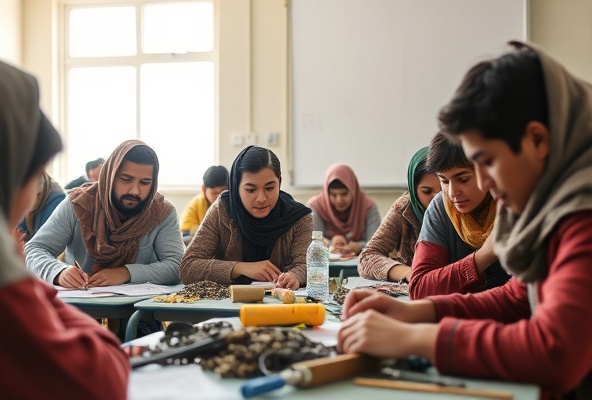
AREA is delighted to announce the graduation of 2,500 youth from its comprehensive Vocational Training Program across Afghanistan. This milestone represents a transformative investment in Afghanistan's youth, equipping young people with practical, market-relevant skills that enable them to secure sustainable livelihoods, create employment opportunities, and contribute meaningfully to their families and communities.
Program Overview & Mission
AREA's Vocational Training and Capacity Building Department operates under the conviction that education and skills development are fundamental to breaking cycles of poverty and creating pathways to dignified livelihoods. The program addresses a critical gap in Afghanistan: while young people possess ambition and energy, many lack access to quality vocational training that connects them with real market demand.
The Vocational Training Program is designed with a dual focus: addressing livelihood vulnerabilities through skills training while promoting social inclusion, gender equity, and community empowerment. By training youth in demand-driven skills, AREA enables them to transition from unemployment and underemployment to productive economic participation.
Training Pathways & Skill Areas
Construction & Building Trades
Youth receive training in essential construction skills including bricklaying, carpentry, plumbing, electrical work, and tile setting. These trades are in high demand as Afghanistan rebuilds infrastructure. Graduates secure employment with construction companies and contractors or establish independent businesses.
Business & Entrepreneurship Development
Rather than seeking employment, many graduates launch their own businesses. AREA provides training in business planning, financial management, marketing, and customer service. This entrepreneurial pathway enables job creation not just for graduates but for their communities.
Agriculture & Agribusiness
For rural youth, AREA offers training in improved agricultural techniques, agribusiness value chains, cooperatives, and market linkages. Graduates become agricultural entrepreneurs, establishing farms or agribusiness enterprises that increase productivity and income for rural families.
Tailoring, Textile & Handicrafts
Particularly popular among women trainees, these programs teach modern garment construction, textile design, and handicraft production. Graduates find employment in tailoring businesses or establish independent tailoring shops and home-based enterprises.
ICT & Digital Skills
Recognizing Afghanistan's digital transformation, AREA trains youth in basic computer skills, mobile phone repair, and digital entrepreneurship. These skills open doors to jobs in the rapidly growing digital economy and online business opportunities.
Hospitality, Tourism & Services
Training encompasses hotel management, catering, food preparation, and customer service. As Afghanistan's tourism sector develops, these skills position graduates for employment in hospitality businesses and service industries.
Comprehensive Curriculum & Methodology
AREA's vocational programs combine theoretical knowledge with intensive practical training. The curriculum includes:
- ✓ Technical Skills: Hands-on training in specific trades using real-world scenarios and equipment
- ✓ Business Skills: Financial literacy, business planning, bookkeeping, and customer relations
- ✓ Soft Skills: Communication, problem-solving, teamwork, and professional conduct
- ✓ Life Skills: Personal hygiene, health awareness, and conflict resolution
- ✓ Job Placement Support: Resume writing, interview preparation, and employer linkages
Demographics & Inclusion
The 2,500 graduates represent diverse demographics across Afghanistan:
- ✓ Gender Diversity: 35% female graduates, exceeding AREA's commitment to gender equity and women's economic empowerment
- ✓ Age Range: Youth aged 16-35, with majority in 18-28 age group
- ✓ Vulnerable Groups: Specific quotas for IDPs, returnees, orphans, and youth from disadvantaged backgrounds
- ✓ Geographic Spread: Trainees from urban, semi-urban, and rural areas across multiple provinces
Employment & Economic Outcomes
Post-graduation tracking reveals strong employment outcomes:
- • 73% Employment Rate: Within 6 months of graduation, over 73% of graduates secure formal employment or establish their own businesses
- • Income Improvement: Average monthly income increased by 250-350% compared to pre-training baseline
- • Business Creation: 32% of graduates established their own microenterprises, creating an estimated 4,200 additional jobs for others
- • Employer Demand: Many employers specifically request AREA-trained workers due to their reliability and competence
Gender Empowerment & Women's Success
A standout feature of AREA's Vocational Training Program is its success in engaging women and girls. Female graduates report transformative impacts:
- ✓ Economic independence and ability to contribute to household income
- ✓ Enhanced decision-making power within families and communities
- ✓ Increased mobility and participation in public and economic spheres
- ✓ Model-effect: Female graduates inspire other women and girls to pursue education and skills training
Community & Family Impact
Beyond individual graduates, the program creates ripple effects throughout families and communities:
- • Households with skilled workers experience improved food security and access to basic services
- • More children stay in school as families can afford education for additional children
- • Communities benefit from improved construction quality, agricultural productivity, and local business activity
- • Graduates become role models, motivating younger siblings and community members to invest in education
Quality Assurance & Trainer Excellence
AREA ensures program quality through rigorous trainer selection, continuous professional development, and curriculum standardization:
- • Trainers possess both technical expertise and pedagogical training
- • Regular refresher courses keep trainers updated with current industry standards
- • Curricula are developed with input from employers and industry experts
- • Completion certificates are recognized by employers and government agencies
Success Stories
Among the 2,500 graduates are transformative personal stories of resilience and achievement. Many began with minimal formal education, family poverty, or social barriers. Through the program, they developed confidence, competence, and economic security. Some have since become trainers themselves, passing their skills to the next generation of Afghan youth.
Future Plans & Scaling
Building on this success, AREA plans to:
- ✓ Train an additional 5,000 youth by 2027, reaching underserved provinces and more vulnerable populations
- ✓ Introduce new training tracks aligned with emerging sectors including renewable energy and ICT
- ✓ Strengthen employer partnerships to guarantee job placement for graduates
- ✓ Expand microfinance and loan guarantee programs enabling graduates to invest in tools and business startup costs
- ✓ Develop mentorship programs pairing successful graduates with current trainees
Building Afghanistan's Future Through Youth
The 2,500 graduates of AREA's Vocational Training Program represent hope, opportunity, and practical transformation. They embody Afghanistan's potential—young people with skills, determination, and dignity, ready to contribute to their families and rebuild their nation.
For more information about the Vocational Training Program or to explore partnership opportunities in skills development, please contact AREA.